
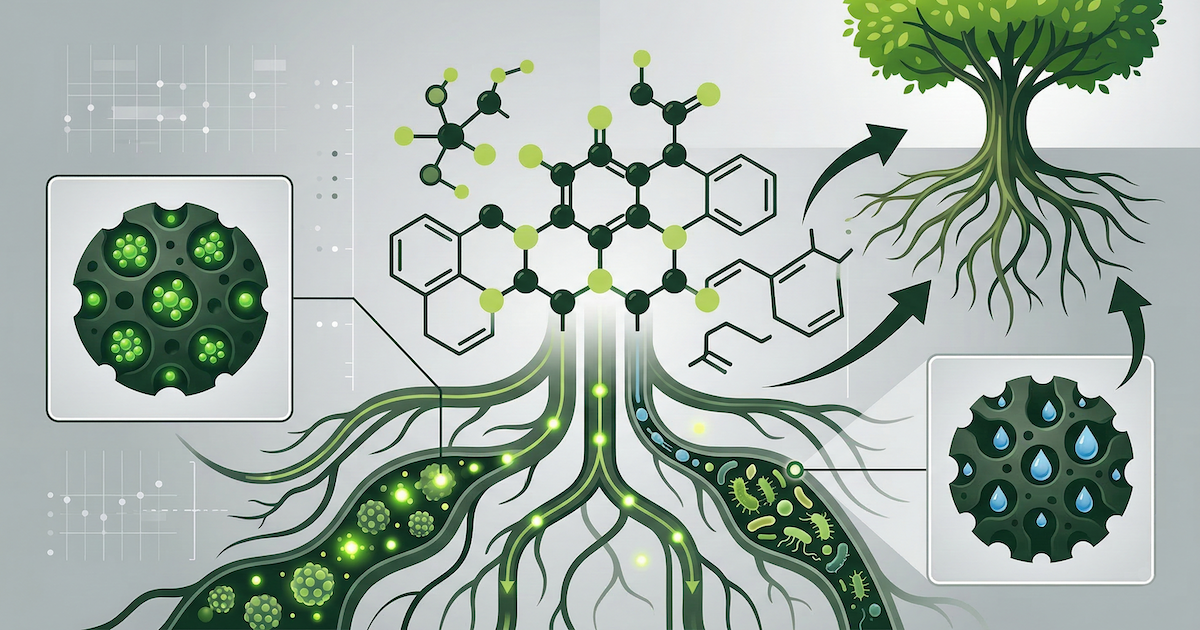
Agriculture stands at a critical crossroads where the demand for immediate yield often compromises the very foundation of our survival: the soil. Chartilizer 101 is not just an introduction to a product; it is a definitive reference guide to a biological and geological shift in land management. Our mission is to bridge the gap between high-output commercial efficiency and the resilient, restorative practices required for long-term food security.
By synthesizing peer-reviewed data from institutions like Nature, Science, and the IPCC with the practical realities of farming in the semi-arid landscapes of Southern Africa and the evolving green mandates of the UK, this article serves as a “North Star” for modern growers. We do not aim to vilify traditional chemistry, but to evolve past a total dependence on it. Through the science of inoculated biochar, we offer a solution that turns “leaky,” exhausted soils into carbon-negative micro-ecosystems. This guide empowers the farmer with honesty—acknowledging the rapid results of synthetics while championing the permanent, drought-resistant, and climate-positive legacy that only a carbon-rich foundation can provide.
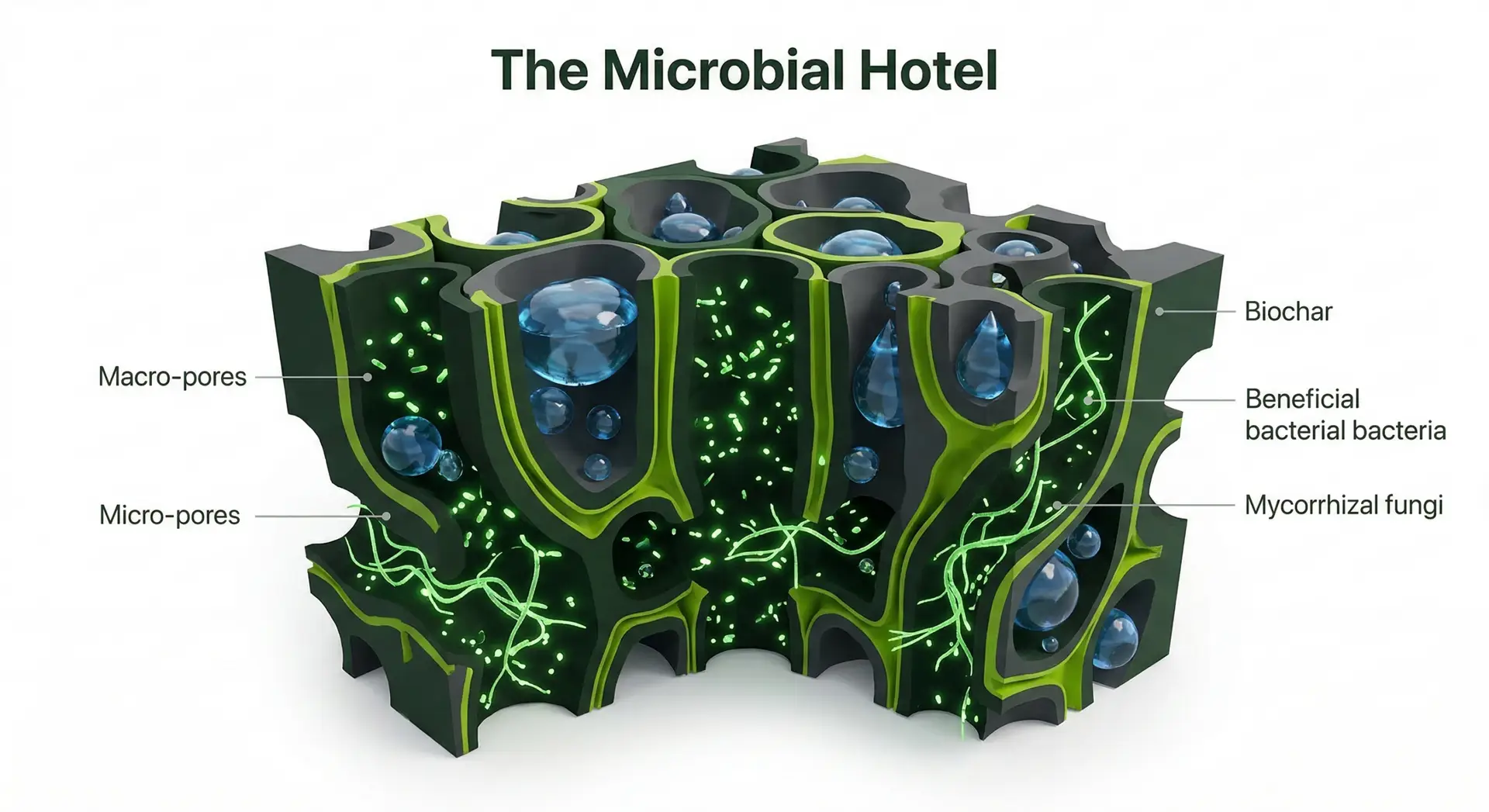
To understand Chartilizer, one must first distinguish between raw biochar and inoculated biochar. While standard biochar is essentially “empty” carbon, Chartilizer is “pre-charged” with a sophisticated blend of nutrients and beneficial microbes.
A helpful analogy for the farmer is to view biochar as the infrastructure—the “hotel”—and the inoculation as the guests—the life. Raw biochar, if applied directly to the soil without inoculation, can actually cause a temporary “nutrient shock” as it absorbs existing soil nitrogen to fill its empty pores. Chartilizer solves this by populating the “hotel” before it ever hits the ground.
At its molecular level, biochar consists of a stable aromatic carbon structure formed via pyrolysis. This structure is what allows it to remain in the soil for centuries without breaking down, unlike compost or manure which mineralize and release their carbon back into the atmosphere within a few years.
The magic of Chartilizer begins with the process of pyrolysis: heating organic biomass (such as invasive wood species) in a high-temperature, low-oxygen environment.
This thermochemical conversion does more than just “burn” the wood; it creates a highly porous material with a massive internal surface area. A single gram of high-quality biochar can have a surface area equivalent to several tennis courts. This physical architecture provides:
Unlike many biochar products that are sold as a dusty, difficult-to-manage “bio-fines,” Chartilizer is a granulated (prilled/pelletized) organic plant nutrition. This is a “globally unique” advancement that allows farmers to use their existing fertilizer spreaders and minimum tillage planters, significantly lowering the barrier to adoption. It combines:
We must be honest: synthetic nitrogen (like Urea or LAN) is excellent for rapid growth. It provides that immediate “green-up” that farmers have relied on for decades. However, treating soil with only synthetic nitrogen is like putting a human on a diet of pure caffeine and sugar—it provides a burst of energy, but eventually, the system crashes.
| Feature | Traditional Nitrogen (Urea/LAN) | Inoculated Biochar (Chartilizer) |
|---|---|---|
| Speed | Immediate "Green-up" | Gradual, sustained release |
| Soil Health | Can lead to acidification & microbial decline | Improves structure, pH, and microbial life |
| Efficiency | High leaching (up to 50% lost to runoff) | Retains nutrients in the root zone |
| Environment | High $N_2O$ emissions (GHG) | Carbon Negative (Sequestrates $CO_2$) |
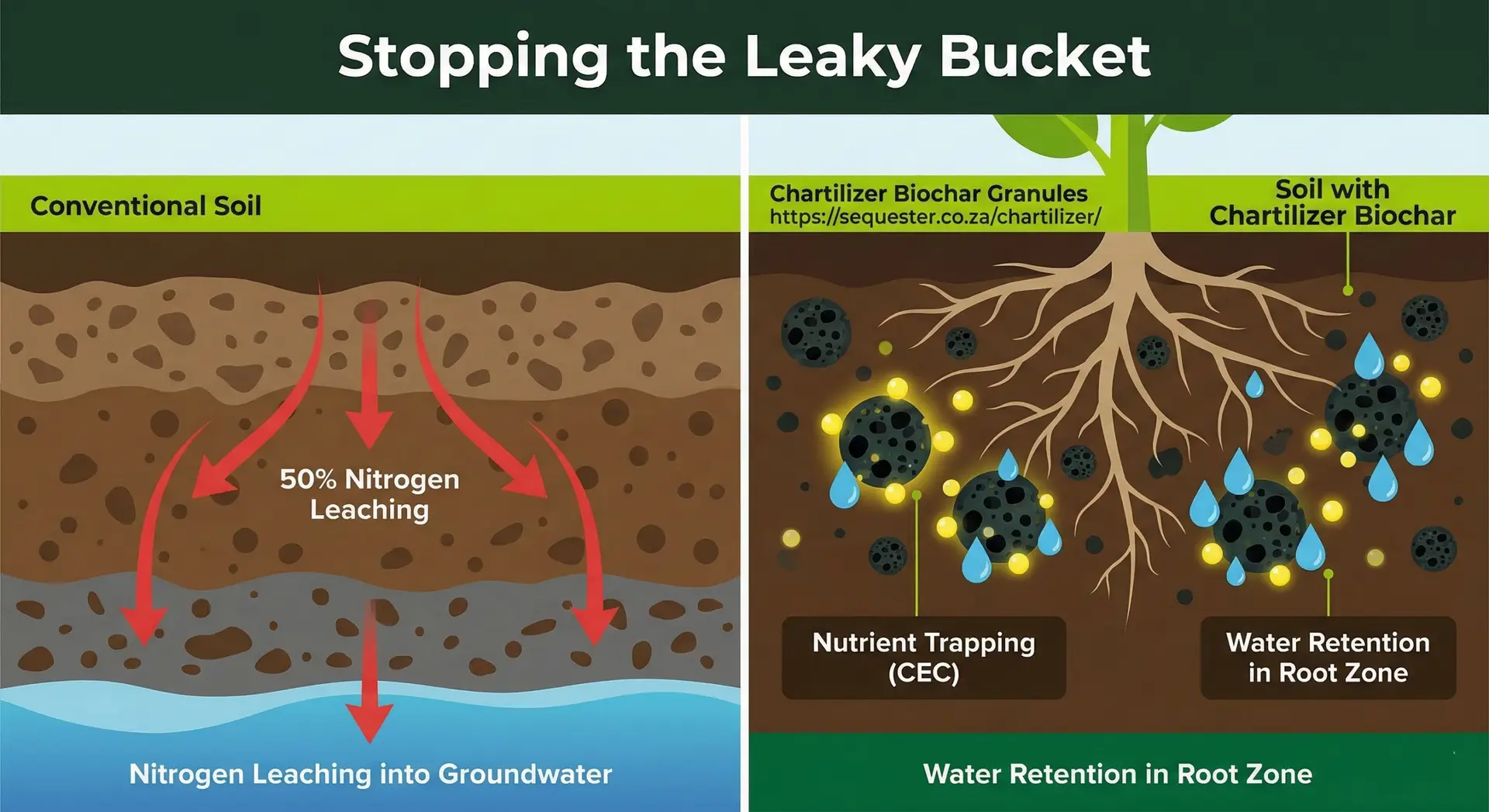
Modern, degraded soils often act like a “leaky bucket”. You can pour as much expensive synthetic fertilizer into the top as you want, but if the soil lacks Cation Exchange Capacity (CEC) and organic structure, up to 50% of those nutrients will simply leach through the soil and into the groundwater.
Chartilizer acts as the “plug” for that bucket. By increasing the soil’s CEC, it holds onto positively charged ions (cations) like Potassium (K), Calcium (Ca2), and Ammonium (NH4), releasing them slowly to the plant as needed. This isn’t just an environmental win; it’s a massive ROI argument for the commercial farmer who is tired of watching their fertilizer budget wash away in the first heavy rain
The benefits of Chartilizer translate across borders, but the primary value propositions shift based on regional challenges.
In the semi-arid regions of the SADC, water is the single most limiting factor in agricultural production. For the 80% of our market in Southern Africa, Chartilizer’s ability to increase Plant Available Water (PAW) is a game-changer.
In the UK, the conversation is increasingly driven by Environmental Land Management schemes (ELMS) and the race to Net Zero.
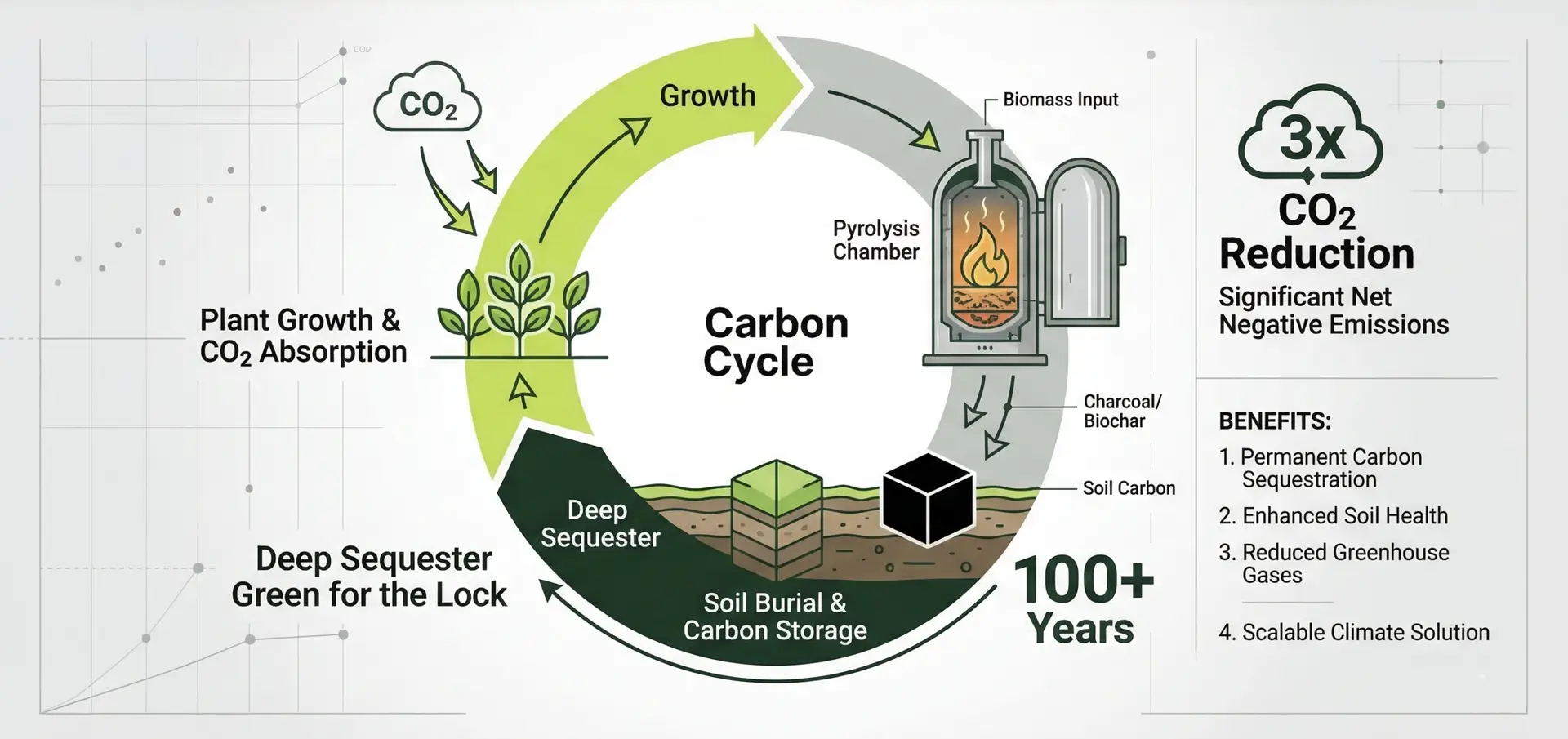
One of the most profound benefits of Chartilizer is its role in reversing the climate impact of agriculture. The IPCC (Intergovernmental Panel on Climate Change) has identified biochar as one of the most stable and cost-effective Negative Emissions Technologies (NETs) available today.
In the natural biological carbon cycle, plants grow (absorbing $CO_2$) and then die and decay (releasing $CO_2$ and $CH_4$ back into the air). By intervening with pyrolysis, Sequester turns this into a geological carbon cycle. We take that carbon and turn it into a stable “rock” that stays in the ground for centuries.
The climate impact is measurable: for every ton of biochar applied to the soil, roughly 2.5 to 3 tons of $CO_2e$ are removed from the atmosphere. This creates a circular financial engine, especially when combined with projects like the Nuwejaars Wetlands, where invasive biomass (an ecological threat) is converted into Chartilizer (an ecological asset).
To dismantle the “snake oil” stigma, we rely on high-authority, peer-reviewed data.
Finding:Biochar increases microbial biomass and alters the community composition of soil, specifically providing a “refuge” for beneficial mycorrhizal fungi that aid in phosphorus uptake.
The “Why”: This explains why Chartilizer’s inoculation is so effective; the microbes aren’t just thrown into the soil—they are given a protected home where they can thrive and multiply like “sourdough or yogurt”.
Finding: Meta-analyses show that biochar-amended soils can reduce nitrogen leaching by up to 11-30%.
The “Why”: It acts as a “slow-release” mechanism for synthetic fertilizers. Instead of one massive spike and then a crash, your crops get a steady “drip-feed” of nutrition throughout the season.
Finding: High-quality biochar has a significant “liming effect,” raising the pH of acidic soils and making nutrients like Phosphorus more available to the plant.
The “Why”: Continuous use of synthetic nitrogen fertilizers often leads to soil acidification over time. Chartilizer reverses this trend, reducing the long-term need for expensive lime applications.
We are moving beyond short-term yield fixes to help farmers build intrinsically resilient systems that thrive against climate volatility. Chartilizer is more than a fertilizer; it is an investment in the natural capital of your land.
Whether you are a commercial grower in the Western Cape targeting 12,000 tons of output, or a UK estate manager looking to secure your Net Zero future, the science is clear: a carbon-rich soil is a profitable soil. Improved soil health increases water retention, reduces dependence on synthetic inputs, and strengthens plant immunity—cutting pesticide needs and lowering production costs over time.
Stop flushing your fertilizer budget down the drain. It is time to turn your “leaky bucket” into a thriving, carbon-negative engine of growth.
Book a Soil Consultation with our agronomists to determine the best application rate for your specific crop and region, or click the link alongside to download our Technical Spec Sheet to see the exact N:P:K ratios of our Chartilizer range.